
OTT & Media Platform Development: Complete Guide for Streaming Businesses in 2026
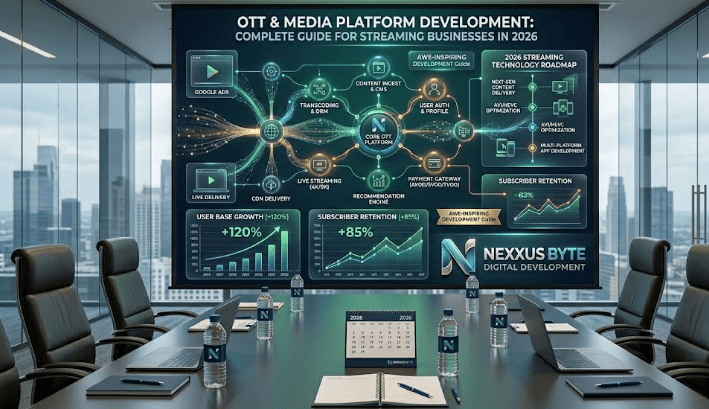
The global OTT (over-the-top) streaming market is projected to exceed $1 trillion by 2027. Entrepreneurs, content creators, broadcasters, and media companies are racing to launch their own streaming platforms as audiences shift away from traditional cable and toward on-demand, subscription, and direct-to-consumer video content.
Whether you are launching a niche content subscription service, a live sports streaming platform, a religious broadcasting channel, or a B2B video training library, the technology choices you make at the outset determine your scalability, user experience, and ultimately your revenue. This guide covers everything you need to know about OTT platform development in 2026.
What Is OTT and Why Is It the Dominant Media Distribution Model
OTT refers to the delivery of video content directly over the internet, bypassing traditional cable or satellite distribution. The term encompasses subscription video on demand (SVOD) services like Netflix and Disney+, advertiser-supported video on demand (AVOD) like Tubi, live streaming services, and hybrid models that combine multiple monetization approaches.
The dominant driver of OTT growth is consumer behavior change. Cord-cutting continues to accelerate across all demographics, with streaming viewing hours surpassing traditional television in most developed markets. For content owners, this creates a direct path to audience monetization that was previously controlled entirely by broadcasters and distributors.
OTT Platform Architecture: The Core Technical Components
Building a scalable OTT platform requires careful architectural decisions across several technical domains.
Video Ingest and Transcoding
Raw video content must be converted into multiple formats and resolutions to support different devices, screen sizes, and network speeds. Modern OTT platforms use adaptive bitrate streaming (ABR), which dynamically adjusts video quality based on the viewer’s available bandwidth. Standards include HLS (HTTP Live Streaming) for Apple devices and MPEG-DASH for most Android and web platforms.
Content Delivery Network (CDN)
A CDN is the infrastructure that delivers your video content to viewers globally with minimal latency and buffering. Major CDN providers for OTT include Cloudflare, AWS CloudFront, and Akamai. For global audiences, multi-CDN strategies using two or more providers simultaneously ensure maximum uptime and performance across geographic regions.
DRM (Digital Rights Management)
Protecting premium content from piracy requires DRM implementation. The three major DRM systems are Widevine (Google, used on Android and Chrome), FairPlay (Apple, used on iOS and Safari), and PlayReady (Microsoft, used on Windows and Xbox). A robust OTT platform implements all three through a multi-DRM solution to cover the full range of devices your audience uses.
User Authentication and Subscription Management
Your platform needs a robust user management system handling registration, login, profile management, subscription billing, payment processing, and access control. This typically integrates with payment processors like Stripe, and subscription management platforms like Recurly or Chargebee for complex billing scenarios including free trials, annual plans, and content tiering.
Monetization Models for OTT Platforms
The monetization model you choose shapes your entire platform design and audience acquisition strategy.
SVOD (subscription) is the most common and highest lifetime value model Netflix’s approach. It requires a critical mass of exclusive or differentiated content to justify ongoing subscription fees. AVOD (advertising-supported) requires scale to generate meaningful ad revenue but has zero barrier to viewer entry. TVOD (transactional) pay per view or rental works well for premium live events, sports, and first-run content. Most successful platforms in 2026 use hybrid models combining two or more of these approaches.
Multi-Platform Development: Where Your Audience Watches
Your OTT platform needs to reach viewers wherever they consume content. A complete multi-platform strategy covers: web app (responsive HTML5 player for desktop and mobile browsers), iOS app (distributed through the Apple App Store), Android app (Google Play Store), connected TV apps (Roku, Amazon Fire TV, Apple TV, Samsung Smart TV, LG WebOS), and optionally Xbox and PlayStation for gaming console audiences.
Each platform has its own approval process, technical requirements, and SDK constraints. Apple and Roku in particular have strict content and technical review processes that require significant lead time before launch. Planning your platform rollout in phases web first, mobile second, connected TV third allows you to build your audience and generate revenue before investing in the more complex and expensive platform ports.
| OTT Platform Development Checklist |
| Define your monetization model before starting development |
| Choose a cloud provider (AWS, Google Cloud, or Azure) for scalable infrastructure |
| Implement multi-DRM from day one retrofitting it later is expensive |
| Design for connected TV from the start even if your V1 is web-only |
| Build your video CMS and metadata structure to support search and discovery features |
| Plan your Apple and Roku app submission timelines allow 4-8 weeks for review |
| Nexxus Byte builds custom OTT and media platforms engineered for scalability, security, and exceptional viewer experience. Whether you are launching a niche streaming service or scaling an existing media business, explore our media technology services at NexxusByte OTT App Development and Media Software Development. |
Frequently Asked Questions
What does OTT platform development cost?
How long does it take to build an OTT platform?
DUI Attorney Near Me: Find Experienced Defense and Protect Your Rights Immediately
You were arrested for driving under the influence. You are frightened. You face potential jail...

Emergency Roof Repair Near Me: How to Find Licensed Contractors and Minimize Storm Damage
A storm just hit your area. Your roof is leaking. Water is dripping into your...

Plano Roofing Companies: How to Get More Leads Without Dependence on Referrals
Plano, Texas has experienced explosive growth over the past decade. Home prices have increased 85...